
All AbMole products are for research use only, cannot be used for human consumption.
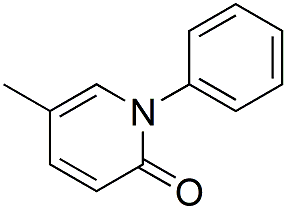
Pirfenidone (AMR69) is an antifibrotic agent that attenuates CCL2 and CCL12 production in fibrocyte cells. Pirfenidone inhibits TGF-β bioactivity by affecting TGF-β2 mRNA expression and processing of pro-TGF-β in CCL-64 cells. In RAW264.7 cells, Pirfenidone suppresses the proinflammatory cytokine TNF-α by a translational mechanism, which is independent of activation of the MAPK2, p38 MAPK, and JNK. In the murine endotoxin shock model, Pirfenidone potently inhibits the production of the proinflammatory cytokines, TNF-α, interferon-γ, and interleukin-6, but enhances the production of the anti-inflammatory cytokine, interleukin-10.
I. Cell Applications
Pirfenidone (50 µM, pre-treatment 30 min before TGF-β1, co-incubated until endpoint) exerts anti-fibrotic effects on human alveolar type II epithelial cells (A549) and human normal lung fibroblasts (MRC5), inhibiting TGF-β1-induced MUC1-CT phosphorylation, β-catenin activation, and SMAD-binding element (SBE) activation, thereby suppressing epithelial-to-mesenchymal transition (EMT), fibroblast-to-myofibroblast transition, fibroblast proliferation, and cellular senescence.
Pirfenidone (100, 500, 1000 µg/ml, 48 h) on human alveolar epithelial cells (A549) significantly inhibits TGF-β1-induced overexpression of type I collagen and HSP47, suppresses overexpression of the mesenchymal marker fibronectin, partially restores epithelial marker E-cadherin expression, and partially reverses the EMT process.
Pirfenidone (0.3, 1.0 mg/ml, 4 h pre-treatment followed by 30 min TGF-β1 stimulation) on human cardiac fibroblasts affects cell proliferation and cell cycle activity for TGF-β1 signaling pathway studies.
Pirfenidone (1.5 g/L, treatment) on neonatal rat cardiac fibroblasts increases miRNA-425-5p expression and decreases TGF-β1 mRNA expression.
Pirfenidone (1.85 µg/mL, 48 h) on human fetal lung fibroblasts (HFL1) inhibits TGF-β1-induced fibrotic marker expression.
II. In Vivo Applications (Mouse)
Pirfenidone (100, 300, 600 mg/kg; dietary admixture; 4 or 14 weeks) in CCl4-induced hepatic fibrosis B6C3F1/J mice: doses of 300 and 600 mg/kg significantly reduce hepatic collagen deposition, lower serum transaminase levels, and prevent hepatocyte ballooning degeneration; in a 14-week sub-chronic study, 300 mg/kg significantly reduces collagen deposition but has minimal effect on inflammatory markers.
Pirfenidone (125 mg/kg; intraperitoneal injection; once daily for 2 weeks) in concanavalin A (ConA)-induced immunological hepatic fibrosis mice significantly reduces type II and IV collagen and α-SMA expression, decreases hydroxyproline content, and lowers serum TGF-β, TNF-α, and TIMP-1 levels while increasing MMP-2 expression.
Pirfenidone (200, 300 mg/kg; oral gavage; once daily for 21 days) in bleomycin (BLM)-induced pulmonary fibrosis C57BL/6 mice: 200 mg/kg reduces Ashcroft fibrosis score, BALF inflammatory cell counts, and hydroxyproline content; 300 mg/kg significantly lowers fibrosis score, inflammation score, lung tissue ROS generation, and MDA levels in blood and BALF.
Pirfenidone (300 mg/kg; oral gavage; once daily for 21 days) in bleomycin-induced pulmonary fibrosis mice, used as positive control, significantly improves respiratory function, lung tissue morphology and structure, inflammatory infiltration, and collagen deposition, reducing fibrotic protein expression.
Pirfenidone (400 mg/kg; oral gavage; once daily for 4 weeks) in pressure overload-induced heart failure C57BL/6J mice reduces HSP47-positive cells and myofibroblasts, improves left ventricular systolic function, and decreases fibrotic area as well as TNF-α, COL1, and TGF-β1 expression.
Pirfenidone (0.5%; dietary admixture) in bleomycin-induced pulmonary fibrosis hamsters reduces lung fibrosis, collagen deposition, and fibrotic marker expression, lowers oxidative stress markers, and improves pulmonary function (lung compliance, total lung capacity, vital capacity, etc.).
III. In Vivo Applications (Rat)
Pirfenidone (100 mg/kg; oral gavage; once daily for 28 days) in bleomycin-induced pulmonary fibrosis SD rats reduces body weight loss, pulmonary edema, Ashcroft fibrosis score, and hydroxyproline content, and increases SOD activity.
Pirfenidone (50 mg/kg; oral gavage; once daily for 14–28 days) in bleomycin-induced pulmonary fibrosis rats reduces lung weight, hydroxyproline content, and neutrophil and leukocyte counts in BALF.
Pirfenidone (500 mg/kg; oral gavage; once daily for 12 weeks) in 5/6 nephrectomy SD rats significantly improves proteinuria and NAG activity, attenuates interstitial fibrosis, decreases expression of TGF-β1, CTGF, α-SMA, fibronectin, and other fibrotic markers, and inhibits M1 and M2 macrophage infiltration.
Pirfenidone (0.6–0.9% or 1%; dietary admixture) in 5/6 nephrectomy or ureteral obstruction rats reduces collagen accumulation, fibrotic marker expression, and improves renal function.
Pirfenidone (200 mg/kg; drinking water; 4 weeks) in streptozotocin (STZ)-induced diabetic Wistar rats reverses cardiac and renal fibrosis, reduces perivascular and interstitial collagen deposition, lowers fibronectin concentrations in heart, kidney, and plasma, and improves diastolic stiffness.
Pirfenidone (0.3 g/kg; oral gavage; once daily for 4 weeks) in myocardial infarction SD rats decreases LVESd and LVEDd, increases LVEF and FS%, alleviates myocardial fibrosis, lowers IL-6, COL1α2, and COL3α1 levels, downregulates TGF-β1/Smad pathway protein expression, and upregulates miRNA-425-5p.
Pirfenidone (50, 100, 200 mg/kg; oral gavage; once daily for 14 days) in acute myocardial infarction SD rats dose-dependently reduces left ventricular mass index, serum TNF-α, IL-6, and TGF-β1 levels, decreases myocardial TGF-β1 and p-Smad/Smad expression, and attenuates pathological damage and fibrosis degree.
Pirfenidone (1.2%; dietary admixture; 4 weeks) in myocardial infarction Sprague-Dawley rats (ischemia-reperfusion model) reduces infarct size by ~50%, decreases left ventricular fibrosis, preserves cardiac function (left ventricular ejection fraction), and lowers susceptibility to ventricular arrhythmias.
Pirfenidone (250–300 mg/kg; dietary admixture; 2 weeks) in DOCA-salt hypertensive Wistar rats reduces cardiac fibrosis, improves left ventricular function, and normalizes collagen deposition and diastolic stiffness.
Pirfenidone (200 mg/kg; oral gavage; once daily for 3 weeks) in CCl4 or bile duct ligation-induced cirrhotic Wistar rats decreases gene expression of collagens I, III, IV, TGF-β, Smad-7, TIMP-1, and PAI-1, reduces hepatic stellate cell activation, lowers perivascular and interstitial collagen, and improves diastolic stiffness.
Pirfenidone (500 mg/kg; oral gavage; once daily for 3 weeks) in CCl4 and bile duct ligation-induced cirrhotic Wistar rats decreases mRNA and protein levels of collagens I and III and α-SMA.
IV. In Vivo Applications (Other Species)
Pirfenidone (0.5%; dietary admixture) in bleomycin-induced pulmonary fibrosis hamsters reduces lung collagen content, prolyl hydroxylase activity, and collagen mRNA expression, lowers oxidative stress markers (lipid peroxidation, SOD, MPO, MDA), and improves pulmonary function parameters.
Pirfenidone (2400 mg; oral; three times daily) in tachycardia pacing-induced heart failure dogs reduces left atrial fibrosis by ~50%, decreases left atrial conduction heterogeneity, and lowers atrial fibrillation susceptibility.
Reference:
https://journal.hep.com.cn/lifemetab/EN/PDF/10.1093/lifemeta/load021
Oku H, et al. Antifibrotic action of pirfenidone and prednisolone: different effects on pulmonary cytokines and growth factors in bleomycin-induced murine pulmonary fibrosis. Eur J Pharmacol. 2008;590:400-408.
https://pmc.ncbi.nlm.nih.gov/articles/PMC9487788/ (cited within review)

Int J Med Sci. 2020 Jul 2;17(12):1692-1703.
TGFβ1 induces bone formation from BMP9-activated Bone Mesenchymal Stem Cells, with possible involvement of non-canonical pathways
Pirfenidone purchased from AbMole
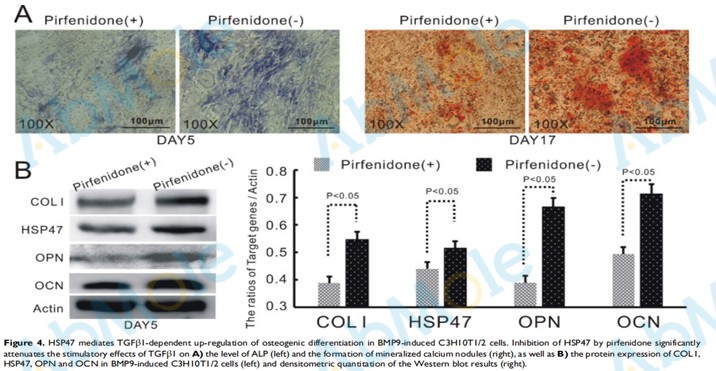 |
Source | Int. J. Med. Sci (2020 Jul). Figure 4. Pirfenidone (Abmole Bioscience, TX, USA) |
| Method | cell culture | |
| Cell Lines | HEK293 and C3H10T1/2 cell lines | |
| Concentrations | 1000 µg/mL | |
| Incubation Time | - | |
| Results | Moreover, pirfenidone could also significantly diminish the protein levels of OPN and OCN |
| Molecular Weight | 185.22 |
| Formula | C12H11NO |
| CAS Number | 53179-13-8 |
| Solubility (25°C) | DMSO 60 mg/mL Water 10 mg/mL (Need ultrasonic) |
| Storage |
Powder -20°C 3 years ; 4°C 2 years In solvent -80°C 6 months ; -20°C 1 month |
| Related TGF-beta/Smad Products |
|---|
| Asiaticoside
Asiaticoside (Madecassol) is the active chemical component of the plant Centella asiatica. |
| Amygdalin
Laetrile is a glycoside initially isolated from the seeds of the tree Prunus dulcis, also known as bitter almonds. |
| Norcantharidin
Norcantharidin |
| Kartogenin
Kartogenin is an activator of the smad4/smad5 pathway, and promotes the selective differentiation of multipotent mesenchymal stem cells into chondrocytes. |
| SIS3 hydrochloride
SIS3 hydrochloride is a novel specific inhibitor of TGF-β1/ALK-5 phosphorylation of Smad3 with an IC50 of 3 µM. |

All AbMole products are for research use only, cannot be used for human consumption or veterinary use. We do not provide products or services to individuals. Please comply with the intended use and do not use AbMole products for any other purpose.
Products are for research use only. Not for human use. We do not sell to patients.
© Copyright 2010-2026 AbMole BioScience. All Rights Reserved.
