
All AbMole products are for research use only, cannot be used for human consumption.
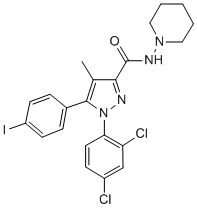
AM251 is a selective cannabinoid 1 (CB1) receptor antagonist with an IC50 of 8 nM. AM251 also acts as a potent GPR55 agonist with an EC50 of 39 nM. AM251 block the inhibitory effects of endocannabinoids and synthetic cannabinoid agonists on transmitter release through an action at presynaptic cannabinoid 1 receptors in brain.
I. Cell Applications
AM251 (10⁻⁶ M, once daily for 3 days) in neonatal rat hippocampal mixed cell cultures antagonizes endocannabinoid signaling and inhibits olfactory ensheathing glia-conditioned medium-induced increase in oligodendroglial process branching complexity, used to study the role of CB1 receptors in oligodendrocyte development.
AM251 (100 nM, co-incubated with 1 µM WIN55212-2 for 2 h) in U2OS-CB1-EGFP redistribution assays antagonizes CB1 receptor internalization with an IC₅₀ of approximately 45 nM, used for CB1 receptor antagonist activity screening.
AM251 (10 µM, 48 h) on human and mouse islet β-cells promotes β-cell proliferation and reduces apoptosis, used to study the regulatory role of the endocannabinoid system in pancreatic function.
AM251 (1 µM, incubation for at least 5 min) on isolated rat dorsal raphe nucleus 5-HT neurons inhibits the firing rate of approximately 50% of recorded neurons; this inhibitory effect is blocked by the GABA_A receptor antagonist picrotoxin, suggesting that CB1 receptors regulate 5-HT neuronal activity via the GABAergic system.
II. In Vivo Applications (Mouse)
AM251 (30 mg/kg; oral gavage; once daily for 7 days) in high-fat diet-induced obese (DIO) C57BL/6 mice significantly reduces food intake and body weight; microCT confirms significant decreases in inguinal subcutaneous, mesenteric, retroperitoneal, and epididymal adipose tissue mass; the anorectic effect attenuates by day 4, but body weight reduction persists throughout the study period.
AM251 (10 mg/kg; intraperitoneal injection; once daily for 4 weeks) in high-fat diet-induced obese C57BL/6 mice rapidly and persistently reduces body weight and decreases inflammatory M1-type adipose tissue macrophage infiltration; mechanistically, it upregulates miR-30e-5p and downregulates its target gene DLL4, inhibiting the DLL4-Notch signaling pathway, thereby suppressing Th1 cell polarization and adipocyte energy storage.
AM251 (1 mg/kg; intraperitoneal injection; once daily for 3 days) in cranial irradiation (9 Gy) C57BL/6 mice, administered starting 30 min post-irradiation, improves cognitive dysfunction at 4 and 12 weeks post-irradiation (novel object recognition and object-in-place tests), and alleviates anxiety- and depressive-like behaviors (elevated plus maze and forced swim tests); the mechanism involves increased hippocampal neurogenesis (1.7-fold increase in DCX⁺ neurons, 2.5-fold increase in BrdU⁺/NeuN⁺ mature neurons) and reduced HMGB1 inflammatory marker expression.
III. In Vivo Applications (Rat)
AM251 (3 mg/kg; intraperitoneal injection; once daily for 6 weeks) in high-fat diet (21% fat)-induced obese SD rats reduces body weight gain (vehicle 655.9 g vs. AM251 607.2 g), significantly decreases epididymal, peri-renal, and brown fat pad weights, reduces plasma leptin, glucagon, ghrelin, and GLP-1 levels, but increases PAI-1 and various pro- and anti-inflammatory cytokine levels; does not induce white adipose tissue "browning" (no change in UCP1 mRNA), suggesting that its weight-loss mechanism is independent of adipose tissue browning.
AM251 (1 mg/kg; intraperitoneal injection; once daily, or 5 mg/kg; once every 5 days) in SD rats produces sustained reductions in food intake and body weight without tolerance; a single 5 mg/kg dose significantly reduces food intake for up to 4 days without inducing conditioned taste aversion (CTA); the central CB1 receptor antagonism disappears after 48 h, suggesting that the sustained anorexic effect is not dependent on persistent central receptor blockade.
AM251 (1 mg/kg; intraperitoneal injection; once daily for 14 weeks) in streptozotocin-induced type 1 diabetic mice significantly reduces albuminuria (by ~50%), an effect independent of body weight, blood glucose, HbA1c, and systolic blood pressure changes, suggesting that CB1 receptor blockade can directly improve glomerular permeability in diabetic nephropathy.
Reference:
https://www.frontiersin.org/journals/cellular-neuroscience/articles/10.3389/fncel.2023.1134130/full
https://www.icrs.com/assets/docs/previoussymposia/ICRS.2002.symposium.pdf
https://pmc.ncbi.nlm.nih.gov/articles/PMC6523050/
https://pmc.ncbi.nlm.nih.gov/articles/PMC8273551/
https://pmc.ncbi.nlm.nih.gov/articles/PMC9569643/
https://pmc.ncbi.nlm.nih.gov/articles/PMC1615836/
https://pmc.ncbi.nlm.nih.gov/articles/PMC2844813/
https://pubmed.ncbi.nlm.nih.gov/31134094/
| Molecular Weight | 555.24 |
| Formula | C22H21Cl2IN4O |
| CAS Number | 183232-66-8 |
| Solubility (25°C) | DMSO 25 mg/mL |
| Storage |
Powder -20°C 3 years ; 4°C 2 years In solvent -80°C 6 months ; -20°C 1 month |
[5] Izabela Bialuk, et al. AM251, cannabinoids receptors ligand, improves recognition memory in rats
| Related Cannabinoid Products |
|---|
| Org 27569
Org 27569 is a potent and selective allosteric modulator of the cannabinoid CB1 receptor. |
| AM1241
AM1241 is a cannabinoid CB2 receptor selective agonist. |
| CP 945598 hydrochloride
CP 945598 hydrochloride is a selective and high affinity CB1 antagonist (Ki values are 0.7 and 0.12 nM in binding and functional assays respectively). |
| AM-2201
AM-2201 is a potent synthetic cannabinoid (CB) with Ki values of 1.0 and 2.6 nM for the CB1 and CB2 receptors, respectively. |
| BML-190
BML-190 is a selective cannabinoid CB2 receptor inverse agonist with Ki of 435 nM, with 50-fold selectivity over CB1 receptor. |

All AbMole products are for research use only, cannot be used for human consumption or veterinary use. We do not provide products or services to individuals. Please comply with the intended use and do not use AbMole products for any other purpose.
Products are for research use only. Not for human use. We do not sell to patients.
© Copyright 2010-2026 AbMole BioScience. All Rights Reserved.
