
All AbMole products are for research use only, cannot be used for human consumption.
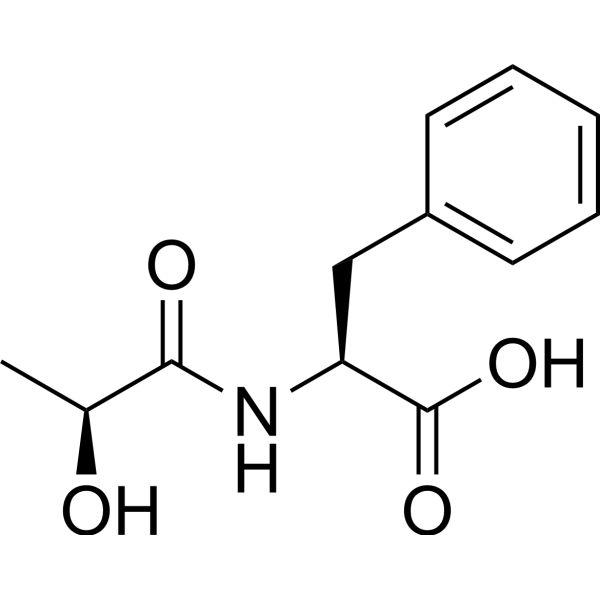
N-Lactoyl-Phenylalanine, a blood-derived signaling metabolite that can be induced by exercise, suppresses feeding and obesity and can be used in obesity research.
General animal information(for reference only)
1) The C57BL/6 mice were divided into 6 groups: Sham group (in which mice had their vertebral laminae pried open but without spinal cord injury, n = 24), SCI group (with spinal cord contusion injury, n = 24), Exercise group (Mice with spinal cord contusion were exercised on a running wheel for 30 min each day. Specifically, the protocol involved starting from the second day after surgery, when the mice regained consciousness from anesthesia and the ability to move freely, and then continuously running on the wheel for 30 min each day, n = 12), L-P group (After the establishment of the spinal cord contusion model, a dose of 20 mg/kg of N-Lactoyl-Phenylalanine was administered via the tail vein every day for a week. The first administration was immediately carried out after the SCI model was established and the wound was sutured. n = 18). 10 mg/kg L-P group (After the establishment of the spinal cord contusion model, a dose of 10 mg/kg of N-Lactoyl-Phenylalanine was administered via the tail vein every day for a week, n = 6). 30 mg/kg L-P group (After the establishment of the spinal cord contusion model, a dose of 30 mg/kg of N-Lactoyl-Phenylalanine was administered via the tail vein every day for a week, n = 6).
2) Mice were maintained in 12-hr light-dark cycles at 22 °C and ~50% relative humidity and fed a standard irradiated rodent chow diet. Where indicated, high-fat diet (Research Diets 60% kcal from fat) was used. For in vivo injection of mice with compounds including Lac-Phe, lactate, and phenylalanine, compounds were dissolved in 18:1:1 (by volume) of saline/Kolliphor EL/DMSO. Compounds were administered to mice daily via intraperitoneal injections at 5 μl/g body weight at the indicated doses. For all injection experiments, mice were mock injected with the vehicle for 3–5 days until body weights have stabilized. For glucose tolerance tests, mice were fasted for 6 hours then injected with glucose at 10 μl/g body weight. A dose of 1 g/kg was used for the GTT of vehicle and Lac-Phe treated obese mice. Sample sizes were determined on the basis of previous experiments using similar methodologies. For metabolite administration experiments, mice were randomly assigned to treatment groups. Experimenters were not blinded to groups.
| Cell Experiment | |
|---|---|
| Cell lines | |
| Preparation method | |
| Concentrations | |
| Incubation time | |
| Animal Experiment | |
|---|---|
| Animal models | High-fat diet-induced obese mice (DIO mice) |
| Formulation | Dissolved in 18:1:1 (by volume) of saline/kolliphor EL/DMSO |
| Dosages | 50 mg/kg |
| Administration | Intraperitoneal injection |
| Molecular Weight | 237.25 |
| Formula | C12H15NO4 |
| CAS Number | 183241-73-8 |
| Form | Solid |
| Solubility (25°C) | Water 15 mg/mL |
| Storage |
Powder -20°C 3 years ; 4°C 2 years In solvent -80°C 6 months ; -20°C 1 month |
[2] Jens Lund et al. Cell Metab. Outrunning obesity with Lac-Phe?
| Related Metabolite/Endogenous Metabolite Products |
|---|
| N-Desmethyl Imatinib
N-Desmethyl Imatinib |
| Desthiazolylmethyloxycarbonyl Ritonavir
Desthiazolylmethyloxycarbonyl Ritonavir is a metabolite of Ritonavir, which is a HIV protease inhibitor. |
| 4-Hydroxy phenyl carvedilol
4-Hydroxyphenyl Carvedilol is a metabolite of Carvedilol, which is a nonselective beta blocker/alpha-1 blocker. |
| Omeprazole sulfone
Omeprazole sulfone is a metabolite of Omeprazole, which is a proton pump inhibitor. |
| Hydroxy Iloperidone
Hydroxy Iloperidone is a metabolite of Iloperidone, which is an atypical antipsychotic. |
All AbMole products are for research use only, cannot be used for human consumption or veterinary use. We do not provide products or services to individuals. Please comply with the intended use and do not use AbMole products for any other purpose.
Products are for research use only. Not for human use. We do not sell to patients.
© Copyright 2010-2026 AbMole BioScience. All Rights Reserved.
